Inference Settings
Configure global and team-specific inference behavior
Inference settings control how requests are processed across a project. Project administrators can maintain one global configuration or create different settings for individual teams.
Open Console > Inference to view the active configuration.
Global settings
The Default team's configuration contains the project's global inference settings. These settings apply automatically when a project does not use custom teams and to every team without its own override.
To change the global settings:
Under Configuration scope, select Default.
Change the required settings.
Click Save Settings.
Teams that inherit the global configuration receive the updated settings automatically.
Override settings for a team
Create an override when one team needs different inference behavior:
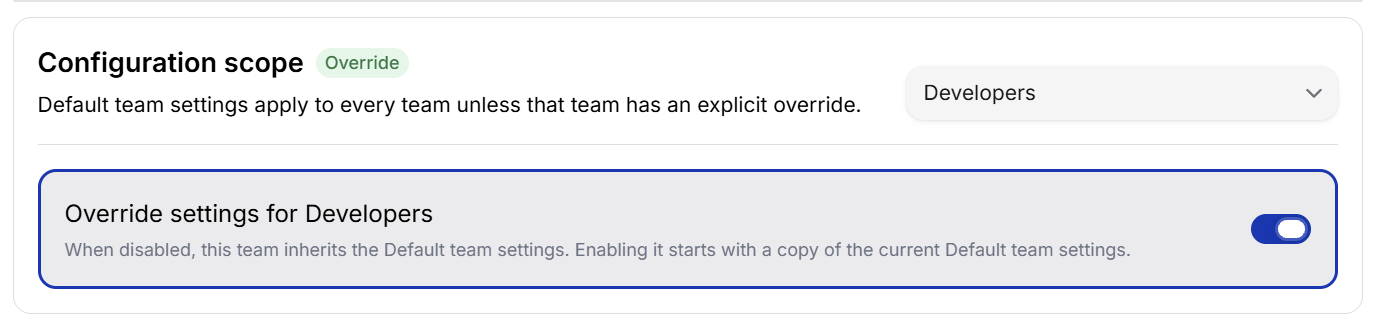
Under Configuration scope, select the team.
Enable Override settings for ....
Change the settings for that team.
Click Save Settings.
When an override is enabled, it starts as a copy of the current Default team settings. You can then change only what the selected team needs.

The scope badge shows how the selected configuration works:
Global
You are viewing the Default team's global settings
Inherited
The team is reusing the Default team settings
Override
The team has its own settings
To return a team to the global settings, select the team and disable its override. The team's separate configuration is removed, and it inherits future changes made to Default.
For information about creating teams and assigning members, see Teams.
Available settings
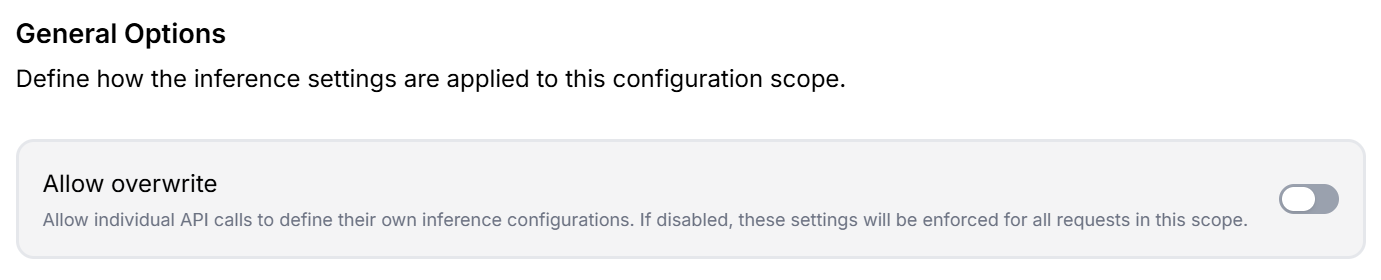
General Options

Allow overwrite
When enabled, an individual API request can supply its own inference configuration. When disabled, the saved settings for the applicable global or team scope are enforced for every request (individual settings get ignored).
Enable it when applications need flexibility for individual requests. Disable it when administrators need a consistent, centrally controlled configuration.
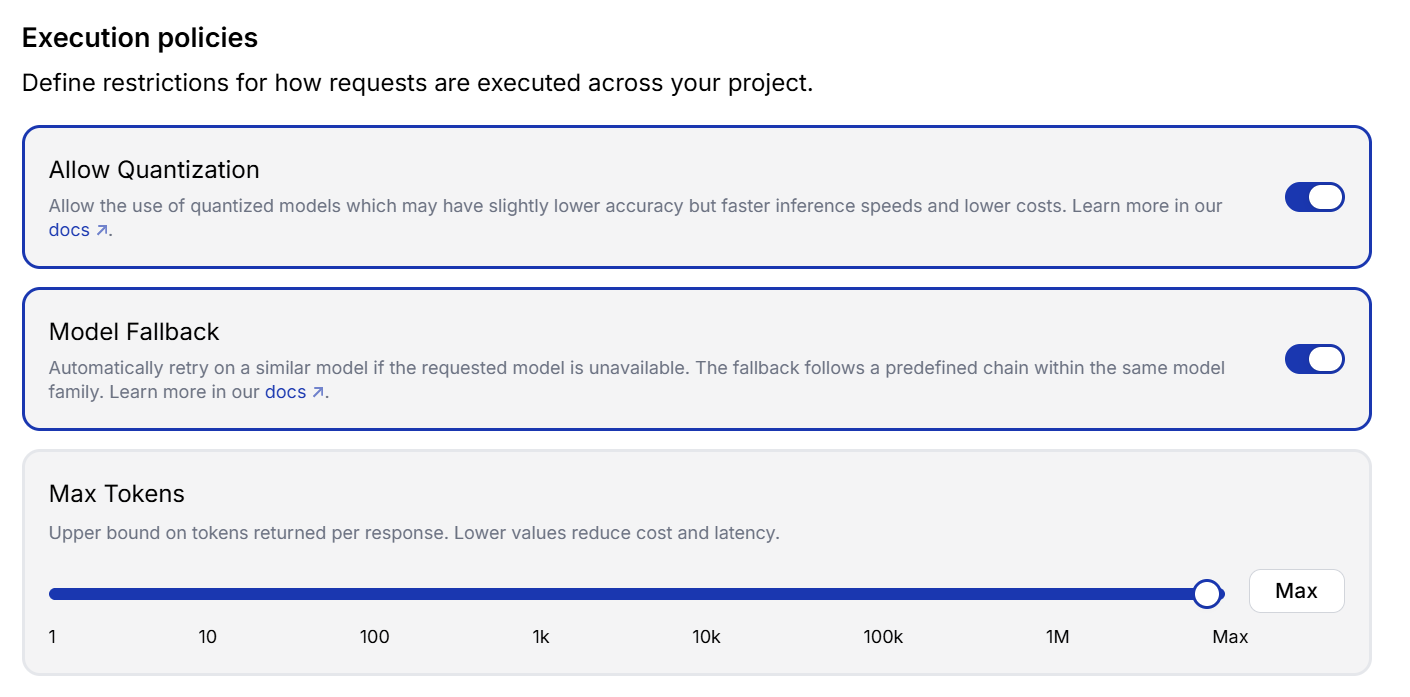
Execution policies

Allow Quantization
Allows requests to use quantized models. These models can provide faster inference and lower costs by using a more compact representation of the model.
Quantization may result in slightly lower accuracy. Disable it when maintaining the highest available model precision is more important than speed or cost.
Model Fallback
Automatically retries a request with a similar model if the requested model is unavailable. The replacement follows a predefined fallback chain within the same model family.
Improves availability, but the request may be processed by a different model variant than the one originally requested.
Max Tokens
Sets the maximum number of tokens that can be returned in a response. Use the slider to choose a limit or select Max to allow the maximum available value.
Lower limits can reduce response time and cost, but may cut off responses that need more space. A response can still finish before reaching the limit.
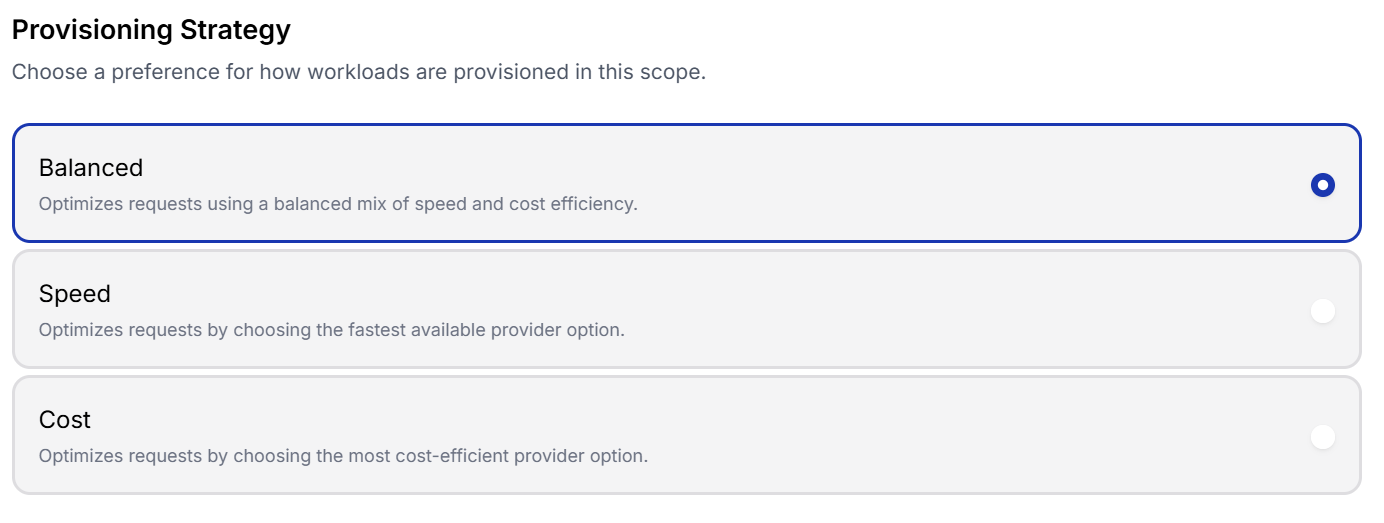
Provisioning Strategy

Balanced
Uses a balanced combination of speed and cost efficiency.
General workloads without a strict speed or cost priority.
Speed
Chooses the fastest available provider option.
Interactive and time-sensitive workloads where low latency is the main priority.
Cost
Chooses the most cost-efficient provider option.
High-volume or flexible workloads where controlling cost is the main priority.
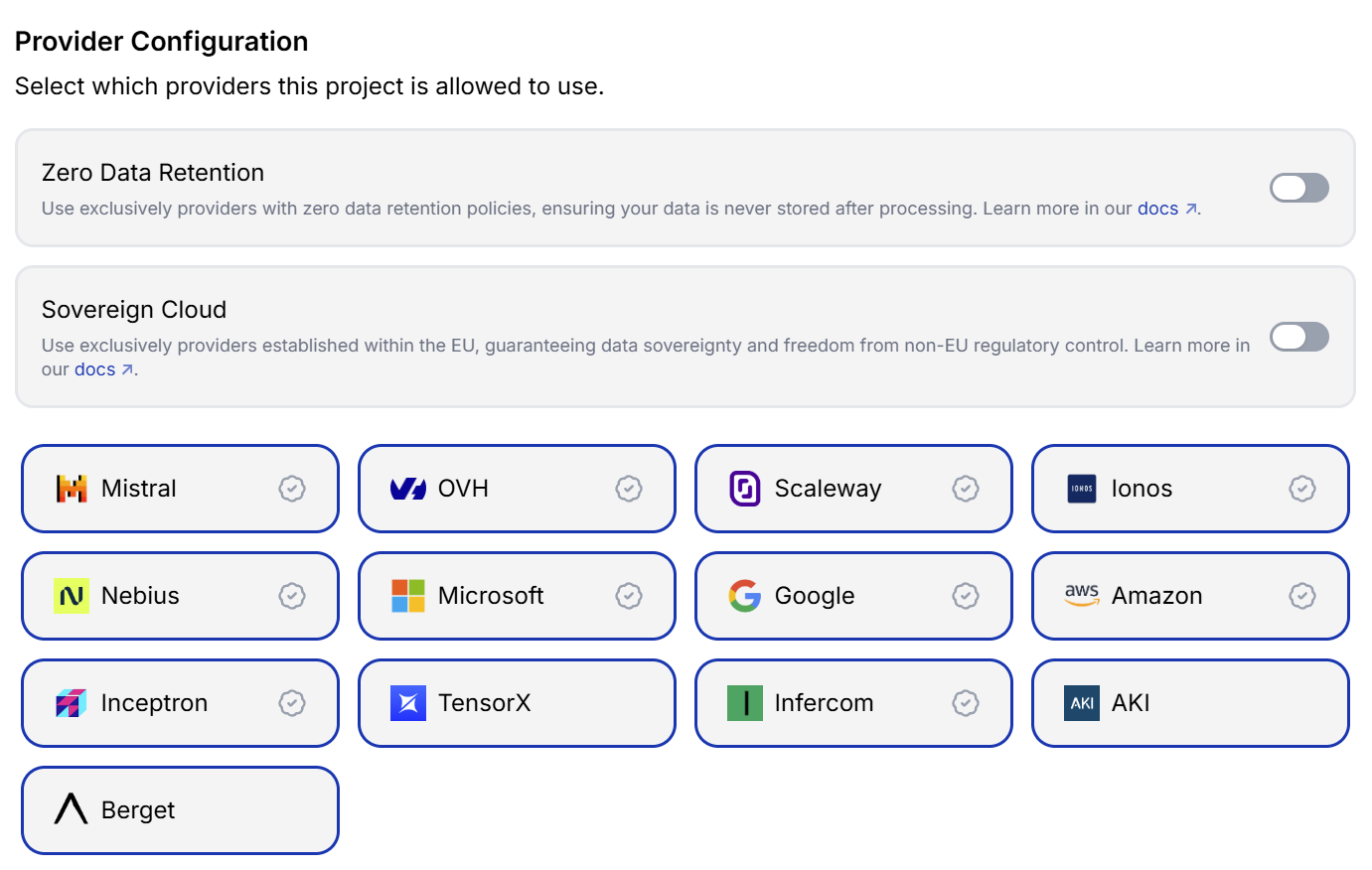
Provider Configuration

Zero Data Retention
Restricts requests to providers with zero data retention policies, so request data is not stored by the provider after processing.
This can reduce the number of providers and models available for a request. Enable it when workloads require zero-retention processing.
Sovereign Cloud
Restricts requests to providers established within the EU to support data sovereignty and limit exposure to non-EU regulatory control.
This can reduce the number of providers and models available for a request. Enable it when EU sovereignty requirements apply.
Individual providers
Determines which providers the project is allowed to use. Select a provider to allow it or clear it to exclude it from request routing.
Limiting the provider list can affect model availability, speed, cost, and fallback options. Provider availability may change over time.
Last updated